
Induction Vs Electric Range €“ Top 10 Key Differences
Choosing the right range can be frustrating, especially when you want faster cooking, easier cleanup, and better energy efficiency without overspending. You’re not alone—many home cooks struggle to decide between induction vs. electric range options.
Induction heats compatible magnetic cookware faster, responds more precisely, uses energy efficiently, and keeps the surface cooler. However, it costs more and requires suitable pans.
Electric ranges generally cost less, accept nearly any cookware, and offer familiar operation. Though they heat and cool more slowly and waste more heat.
Both need proper electrical installation. Consider your cooking habits, safety needs, cleaning preferences, and budget to find your best match, and discover how each difference affects your choice.
Key Takeaways
- Heating method: Induction heats compatible cookware directly, while electric ranges warm pans through coils or radiant elements.
- Speed and control: Induction boils water faster and adjusts temperature almost instantly. Electric ranges heat and cool more slowly.
- Cookware compatibility: Induction requires magnetic cookware, whereas electric ranges work with nearly any pan.
- Efficiency and cost: Induction wastes less energy but costs more initially. Electric ranges are generally cheaper to purchase.
- Safety and cleaning: Induction surfaces stay cooler and are easier to clean, while electric elements retain heat and may require more maintenance.
How Induction and Electric Heating Work

Induction cooktops create heat directly in compatible cookware by using electromagnetic energy to generate currents in the pan. With induction technology, a copper coil beneath the glass surface produces a magnetic field when you turn on a cooking zone.
Induction cooktops use electromagnetic energy to heat compatible cookware directly, keeping the cooking surface relatively cooler.
Place a magnetic pan over it, and the field induces electrical currents in the pan’s base. The pan itself becomes the heat source, while the cooktop remains relatively cooler.
Electric ranges use electric heating elements instead. When you select a setting, electricity flows through a resistance wire inside a coil, radiant element, or smooth-top heating zone.
That wire heats up, then transfers heat to your cookware through contact. The surface may also retain heat after you switch it off, so handle it carefully.
You’ll need compatible, magnetic cookware for induction, whereas electric ranges accept nearly any flat-bottomed pan. Both systems rely on electricity, but they deliver energy to your cookware through different mechanisms.
Which Range Cooks Faster?
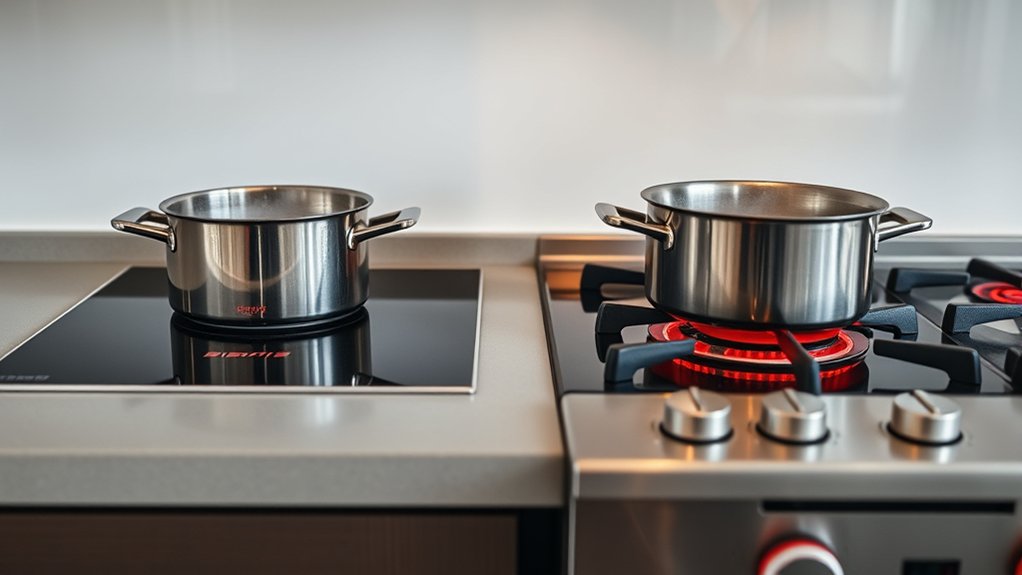
Induction usually boils water faster than a traditional electric range. It responds almost immediately, while electric coils take longer to heat up and cool down. Let’s compare their boiling speeds and response times to help you choose the faster option.
Boiling Speed Comparison
When it comes to boiling water, induction ranges usually cook faster than electric coil or smooth-top ranges because they transfer heat directly to the cookware.
You’ll often see a pot reach a rolling boil several minutes sooner, especially when you heat larger quantities. This direct energy transfer improves boiling efficiency because less heat escapes into the surrounding surface and air.
Induction also delivers rapid heating with relatively low wattage, helping you save time during meal preparation.
Electric ranges can still boil water effectively, but their heating elements warm the glass surface or coil first, which then heats the pan. As a result, they generally need more time to reach the same temperature.
Your cookware size, water volume, and power setting also affect the final boiling time.
Heat Response Time
Heat response time measures how quickly a range reaches your chosen temperature and reacts when you adjust the controls. Induction usually cooks faster because it transfers energy directly into compatible cookware.
You’ll get nearly instant heating and precise temperature changes, which helps prevent scorching and speeds everyday meals. Electric ranges heat a burner gradually and retain heat after you lower or switch off the control.
- Induction boils water quickly and responds almost instantly.
- Electric burners take longer to heat and cool.
- Induction improves Energy efficiency by reducing wasted heat.
- Electric models may offer helpful Safety features, including residual-heat indicators.
Choose induction if you value rapid starts, quick adjustments, and consistent control. Choose electric if you prefer lower upfront costs and broad cookware compatibility.
Which Cooktop Offers Better Temperature Control?

When you adjust the heat, an induction cooktop responds almost instantly, giving you precise control. Electric cooktops react more slowly because their elements stay hot even after you lower the setting. You’ll notice the difference when cooking delicate foods or making quick temperature changes.
Precise Heat Adjustments
Induction cooktops offer more precise heat adjustments because they change the cookware’s temperature almost instantly when you raise or lower the setting. You’ll get finer control than with a traditional electric range, whose heating element cycles on and off.
This difference helps you manage delicate recipes and maintain reliable results across different pans.
- Temperature consistency: Your food stays closer to the selected heat, reducing scorching and uneven cooking.
- Power efficiency: You’ll direct energy into the cookware instead of warming the surrounding surface.
- Fine settings: You can choose lower, steadier heat for melting chocolate or simmering sauces.
- Accurate cooking: You’ll find it easier to follow recipes that require specific temperature ranges.
Electric ranges can still perform well, especially with quality controls and suitable cookware. However, induction generally gives you greater precision and control during everyday cooking.
Responsive Temperature Changes
For responsive temperature changes, induction generally gives you better control because it adjusts the cookware’s heat almost immediately after you change the setting. You can lower the power to prevent boiling over or raise it quickly when you need more heat.
Since the pan responds directly, you’ll experience less temperature fluctuation during delicate tasks, such as melting chocolate or simmering sauces. An electric range typically takes longer to react.
Its heating element remains hot after you reduce the setting, so your food may continue cooking and require careful timing. You’ll also notice slower recovery when you increase the heat, especially with heavier cookware.
Although electric models can provide steady cooking once heated, induction usually delivers superior heat consistency and lets you manage changes with greater confidence.
Does Induction or Electric Use Less Energy?
Induction cooktops generally use less energy than traditional electric ranges because they transfer heat directly to the cookware instead of heating a burner first. This improved energy efficiency means you’ll waste less power while boiling, simmering, or frying.
Traditional electric elements radiate heat into the room and lose some energy between the burner and pan, while induction transfers most generated heat into compatible cookware.
Your actual savings depend on cooking habits, electricity rates, and appliance wattage. However, induction often reaches cooking temperatures faster, so you may run it for less time.
For a practical cost comparison, consider both purchase price and long-term electricity use.
- Induction directs energy into the pan.
- Electric burners lose more heat around the pan.
- Faster cooking can reduce operating time.
- Lower energy consumption may trim utility costs.
To maximize savings, match pan size to the cooking zone, use lids when appropriate, and turn the appliance off promptly after cooking.
Check your utility rate before estimating monthly savings, since local prices influence your results.
Which Range Is Safer for Your Kitchen?
When kitchen safety is your priority, induction ranges generally offer an advantage because their cooking surfaces stay cooler and heat only compatible cookware. You’ll reduce the risk of accidental burns when you touch the area around a pot, although the cookware itself remains hot.
Many models also include automatic shutoff, pan detection, child locks, residual-heat indicators, and overflow protection. These safety features help prevent unattended cooking accidents and give you better control during busy meal preparation.
Automatic shutoff, pan detection, child locks, and overflow protection help make induction cooking safer and more manageable.
Electric ranges can still provide dependable protection, especially when you choose a model with sturdy controls, hot-surface warnings, and automatic shutoff. However, their radiant burners stay hot after you remove cookware, so you’ll need to watch children, pets, and loose towels around the cooktop.
Both options require careful handling, but induction often combines faster response with greater user convenience. Whichever range you choose, keep flammable items away, use appropriate cookware, and turn controls off after cooking.
Are Your Pans Compatible With Induction?
Before using an induction range, make sure your pans are compatible with magnetic heat. Test each pan with a magnet, then check whether it’s made from an induction-ready material.
Check For Magnetic Compatibility
To check whether your pans will work on an induction range, place a magnet against the bottom of each one. If it sticks firmly, your pan likely has the necessary magnetic compatibility.
A weak attraction may produce inconsistent heating, while no attraction means the pan won’t activate the cooktop. Check every piece individually, even if it belongs to a matching set.
- Test the entire base, not just the center.
- Clean the bottom before testing for reliable contact.
- Watch for warped surfaces that may heat unevenly.
- Label compatible pans so you’ll find them quickly.
Your cookware materials determine how strongly the magnet reacts. Keep this simple test handy when replacing pans or shopping for additions.
If a pan passes, confirm its base is flat and appropriately sized for your induction range before cooking.
Identify Induction-Ready Materials
Induction-ready pans usually contain magnetic materials such as cast iron, carbon steel, or stainless steel with a magnetic base. These materials interact with the cooktop’s magnetic field, allowing the pan to heat efficiently.
For reliable material compatibility, check your cookware’s packaging or look for an induction symbol on its bottom. You can also perform a simple magnetic test by placing a refrigerator magnet against the pan’s underside.
If it sticks firmly, the pan will likely work on an induction range. A weak attraction may produce uneven heating, while no attraction means the pan isn’t compatible.
Keep in mind that material isn’t the only consideration. Choose a flat, smooth base that fully contacts the cooking zone.
Avoid warped pans, which may heat poorly even when their metal responds to the magnetic field.
Which Cooktop Is Easier to Clean?
Induction cooktops are generally easier to clean because their smooth, flat surfaces have no grates or exposed heating elements to trap spills. Since the surface stays relatively cooler around the pan, food usually won’t bake on as quickly. You can wipe it with a soft cloth and cooktop cleaner once it cools.
Electric cooktops also offer a flat surface, but exposed coils and raised drip pans create extra cleaning work. Smooth-top electric models are simpler, although stubborn, burned-on residue may require a scraper designed for glass cooktops.
Follow these cleaning tips:
- Wipe spills promptly after cooking.
- Use a nonabrasive sponge to prevent scratches.
- Remove cookware before cleaning the surface.
- Choose manufacturer-approved cleaner for stubborn marks.
Your maintenance routines should include checking for residue around controls and drying the surface completely. Avoid steel wool, harsh powders, and dragging pans across either cooktop.
What Installation Does Each Range Require?
Installation requirements differ mainly in the power supply and ventilation setup. Both induction and electric ranges typically need a dedicated circuit, but you’ll need to confirm the manufacturer’s electrical specifications before installation.
Many models use a 240-volt connection, while some compact units operate on 120 volts. Check power outlet compatibility carefully, because the receptacle must match the range’s voltage, amperage, and plug configuration.
A qualified electrician can install the correct outlet and safely connect hardwired models. Induction ranges don’t require gas lines or special ventilation beyond what you’d normally use for cooking.
Their smooth, efficient heating can reduce excess heat in your kitchen, but you’ll still benefit from a range hood or exhaust fan to remove smoke and odors. Electric radiant ranges have similar ventilation needs and also avoid gas plumbing.
Before delivery, measure the opening, verify countertop clearance, and confirm your electrical panel can support the appliance. Professional installation helps you avoid wiring problems, damaged components, and safety hazards.
How Much Do Induction and Electric Ranges Cost?
Price is often the biggest difference between these two range types. In a typical cost comparison, electric ranges usually have the lower purchase price, while induction models often cost more because of their advanced technology.
You’ll also need compatible cookware for induction, which can increase your initial investment.
Several price factors affect your final spending:
- Purchase price: Basic electric ranges often cost less than comparable induction models.
- Cookware: You may need magnetic pots and pans for an induction cooktop.
- Installation: Both ranges can involve delivery, electrical work, and removal fees.
- Operating costs: Induction generally uses energy more efficiently, potentially lowering utility bills over time.
Your budget, available cookware, and expected usage should guide the decision. Although an electric range may save you money upfront, an induction range could offer greater long-term value through reduced energy consumption.
Compare warranties, controls, capacity, and included features before buying, since similar-looking models can have substantially different prices. Check current retailer promotions, too, because seasonal discounts may narrow the gap.
Which Cooktop Is Best for Your Cooking Style?
Your cooking habits may matter more than the initial price when choosing between these cooktops. If you value speed, precise temperature changes, and energy efficiency, induction suits your routine.
It heats compatible pans quickly and keeps the surrounding surface relatively cool, which helps busy cooks and families. However, you’ll need magnetic cookware, so check your pots before switching.
Choose an electric cooktop if you want broad cookware compatibility, straightforward operation, and a typically lower purchase price. Its smooth surface accommodates most flat-bottomed pans, though heating and cooling take longer.
Electric models may also fit your budget when you cook occasionally or prefer familiar controls.
Consider Cooking versatility, too. Induction excels at simmering, searing, and boiling, while electric offers dependable performance for everyday meals.
Finally, compare Design aesthetics with your kitchen. Both styles create a clean, modern appearance, but induction often delivers a more streamlined look.
Match the cooktop to your priorities, cookware, and typical recipes for the best fit.
Frequently Asked Questions
How Long Do Induction and Electric Ranges Typically Last?
You can expect an induction range to last about 10–15 years, while an electric range typically lasts 13–15 years. Your actual lifespan depends on usage, maintenance, and component quality.
Induction models may need pricier repairs, especially for electronic controls. Energy efficiency doesn’t necessarily determine durability, but it can reduce operating costs.
Check installation requirements carefully. Proper electrical service, ventilation, leveling, and professional setup help your range perform reliably and reach its expected lifespan.
Do Induction Ranges Make Noise While Operating?
Yes, you’ll hear some noise from an induction range, though it’s usually gentle: a faint hum, buzz, or soft clicking beneath your pan, like a quiet electronic whisper. Noise levels vary with cooking power and cookware compatibility.
Lightweight, uneven, or poorly matched pans may vibrate and sound louder, while heavy, flat cookware typically stays quieter. Cooling fans can also run after cooking, creating a steady whoosh until the range cools completely.
Can Induction Cookware Damage or Scratch the Cooktop Surface?
Induction cookware usually won’t damage or scratch your cooktop if you handle it carefully. Choose smooth, flat-bottomed pots and pans designed for induction, and lift them instead of sliding them across the glass.
Surface durability is generally excellent, but trapped grit, rough cast iron, or damaged cookware can leave marks. Keep the cooking area clean, inspect pan bottoms, and avoid dropping heavy cookware onto the surface during use.
Are Replacement Parts Readily Available for Both Range Types?
You’ll generally find replacement parts readily available for both induction and electric ranges through manufacturers, appliance retailers, and authorized service centers. Electric ranges often offer cheaper, more widely stocked components because their designs are simpler and more common.
Induction models may require specialized control boards, sensors, or glass, which can cost more and take longer to source. For better Cooktop durability and Energy efficiency, choose a reputable brand with strong parts support and warranty coverage.
Do Induction and Electric Ranges Affect Kitchen Ventilation Needs?
Think of your range as a quiet partner in kitchen air quality: you’ll generally need similar ventilation for induction and electric cooking. Both produce steam, odors, and smoke extraction demands, even though neither burns gas.
Induction often improves ventilation efficiency because it transfers heat directly, releases less excess heat, and may reduce lingering fumes. You should still use a properly sized hood, run it during cooking, and continue briefly afterward for best results.
Conclusion
Choosing between an induction and electric range comes down to how you cook, what you value, and what your kitchen can support. Induction usually wins on speed, control, safety, and efficiency, while electric ranges offer lower upfront costs and broader cookware compatibility.
Coincidentally, the pan you already own may make the decision for you: if a magnet sticks, you’re ready for induction. Otherwise, electric keeps things simple, affordable, and familiar. Overall, these induction vs electric range differences can help you choose the best option for your kitchen.


